In an age dominated by speed, distraction, and digital noise, spaces that invite contemplation have become increasingly rare. Yet on Tunisia’s northeastern coast, near the calm landscapes of Maâmoura, a unique artistic experience is quietly emerging, one that seeks not only to exhibit art, but to redefine the role of culture in everyday life
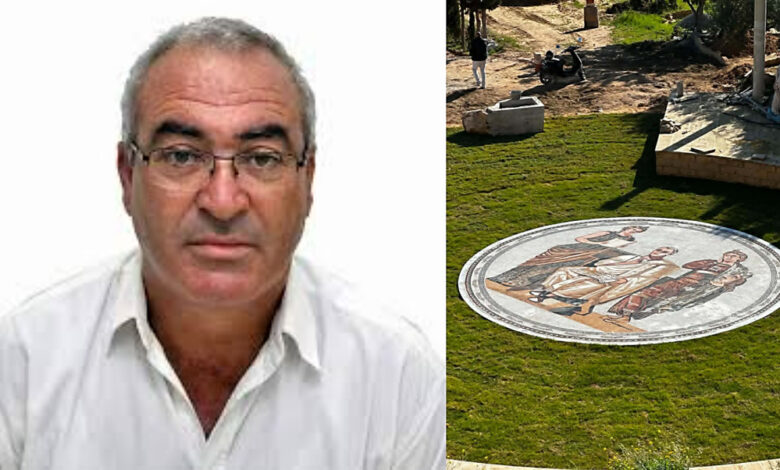
At the center of this vision stands Tunisian visual artist Taïeb Zioud, whose work in mosaic art has earned recognition far beyond the borders of his homeland. Rather than treating mosaic as a decorative craft tied to the past, Zioud approaches it as a living language capable of expressing memory, emotion, and the fragile complexity of human existence
His artistic philosophy is rooted in transformation. Stone, glass, texture, and color are not static materials in his hands; they become emotional elements assembled into visual narratives. Each composition invites the viewer to pause, reflect, and reconnect with something deeper than appearance
Zioud’s journey began on the island of Djerba, a place long celebrated for its cultural diversity and artisanal heritage. Growing up in Mellita, he was surrounded by traditional architecture, handmade crafts, and the layered traces of Mediterranean civilizations. These early impressions shaped his sensitivity to form and symbolism, but they also taught him that art is inseparable from identity and collective memory
Over time, he developed a style that bridges heritage and modernity. His mosaics preserve the precision and patience of ancient techniques while embracing contemporary themes related to belonging, spirituality, exile, and the search for meaning. This balance gives his work a distinctive voice, one that feels both timeless and profoundly current
One of his most compelling recent contributions can be found in the cultural space known as « Rivim, » where nature and artistic creation are intentionally intertwined. Rather than functioning as a conventional cultural center, Rivem was imagined as a place where people could experience art organically, outside rigid institutional structures. Here, exhibitions, performances, and public encounters unfold in direct dialogue with the surrounding environment
Zioud’s presence within this project is particularly significant because his mosaics do more than embellish the space; they shape its emotional identity. His monumental circular artwork inspired by the Roman poet Virgil, installed at the heart of the amphitheater esplanade
The piece does not impose itself through grandeur alone. Its power lies in its atmosphere. Visitors walking across the mosaic experience an almost subconscious transition, from movement to stillness, from external noise to inner reflection. The artwork creates a silent conversation between literature, philosophy, architecture, and landscape
By invoking Virgil, Zioud also reconnects the Mediterranean with one of its oldest intellectual traditions: the idea that art can help humanity endure uncertainty. Virgil wrote about wandering,
loss, resilience, and the desire to find purpose in unstable times. These themes remain strikingly relevant today, which gives the mosaic a contemporary resonance despite its classical inspiration
What makes Zioud’s work especially powerful is his understanding of fragmentation. Mosaic, by nature, is composed of broken elements assembled into unity. This process mirrors modern human experience itself. Contemporary life often leaves individuals emotionally fragmented, divided between memory and ambition, isolation and connection, speed and emptiness. Through his art, Zioud transforms fragmentation into coherence
His mosaics suggest that beauty is not born from perfection, but from reconstruction. Broken pieces gain meaning when they become part of a larger vision. In this sense, his work carries a deeply human message: healing is possible, not through erasing fractures, but through learning how to integrate them
This perspective gives his art a spiritual dimension without becoming abstract or inaccessible. People encountering his work do not need specialized knowledge to feel its emotional force. The materials remain grounded, tactile, and familiar, yet the experience they create opens toward reflection and introspection
In the end, Taïeb Zioud’s art is not simply about mosaic; it is about restoring dialogue, between past and present, between human beings and their environment, and between fragmented lives searching for meaning in an increasingly restless world. Through patience, craftsmanship, and poetic vision, he transforms ordinary materials into spaces of contemplation and emotional connection. His work reminds us that art still possesses the power to slow time, awaken memory, and bring people closer to themselves and to one another
In Rivim, mosaic is no longer confined to history or decoration; it becomes a living testimony that beauty, when rooted in authenticity and shared humanity, can still heal, unite, and endure
Malek Chouchi