In the sunlit courtyards of Tunis, where history lingers in every stone and every conversation carries echoes of revolution, resilience, and renewal, a new diplomatic chapter is quietly unfolding. At its center stands Bill Bazzi, whose first months as the United States Ambassador to Tunisia have already been marked by an ambitious vision: deepen strategic cooperation, unlock economic opportunity, and reaffirm a friendship that has endured for more than two centuries
But beyond the official meetings, policy statements, and ceremonial handshakes, Ambassador Bazzi’s message has carried a deeper tone, one rooted not only in diplomacy, but in continuity
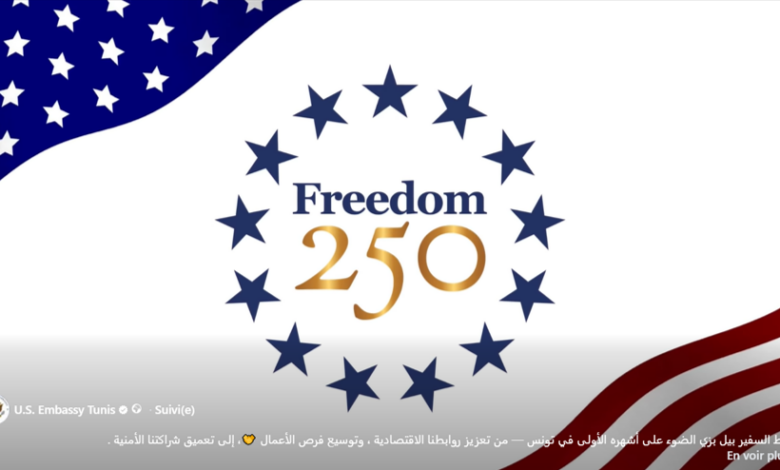
As the United States launches the nationwide and international commemoration of Freedom250, celebrating 250 years of American independence, Tunisia is simultaneously marking its own milestone: the 70th anniversary of Tunisian independence. Together, these anniversaries are more than symbolic. They are a reminder that the relationship between Washington and Tunis is among the oldest America has maintained in the Arab world
From the historic Treaty of Friendship signed in 1797 to today’s multifaceted cooperation in trade, education, innovation, and security, the partnership has remained remarkably resilient
A Strategic Partnership at a Defining Moment
Ambassador Bazzi arrived in Tunisia at a moment of both challenge and opportunity. Tunisia continues to navigate economic pressures, regional instability, and evolving political dynamics. Yet despite global uncertainty, the United States has signaled that Tunisia remains a critical partner in North Africa and the Mediterranean
In his early engagements with Tunisian officials, entrepreneurs, civil society leaders, and youth innovators, Ambassador Bazzi has emphasized a pragmatic but optimistic agenda: strengthening economic ties while expanding pathways for investment and entrepreneurship
That focus comes at a pivotal time
Tunisia’s strategic geographic position, situated between Europe, Africa, and the Middle East, has long made it a gateway for commerce and diplomacy. American officials increasingly see the country not only as a security ally, but also as an emerging hub for technology, manufacturing, renewable energy, and regional trade
For Ambassador Bazzi, economic diplomacy appears to be central to the mission
Across meetings with business leaders and investors, the message has been consistent: stronger U.S.–Tunisian economic cooperation can generate jobs, encourage innovation, and create new opportunities for young Tunisians seeking stability and growth in a rapidly changing global economy
Beyond Economics: A Shared Security Vision
Yet the relationship extends well beyond commerce
Over the past decade, Tunisia and the United States have built a robust security partnership focused on counterterrorism cooperation, regional stability, border security, and military modernization. Tunisia’s designation as a Major Non-NATO Ally has reinforced its strategic importance to Washington
Ambassador Bazzi’s first months have reaffirmed that security cooperation remains a cornerstone of bilateral relations
At a time when North Africa faces growing transnational threats, from terrorism and cyber insecurity to irregular migration and regional conflict, the U.S.–Tunisian alliance has become increasingly significant. American support has included military training, equipment modernization, intelligence coordination, and joint exercises designed to strengthen Tunisia’s institutional resilience
But officials on both sides increasingly stress that security today cannot be separated from economic and social development. Stability, they argue, is built not only through defense partnerships, but through opportunity, education, and public trust
That broader understanding appears to shape Ambassador Bazzi’s approach
Freedom250: Celebrating Independence, Innovation, and Enduring Friendship
The launch of #Freedom250 adds another powerful dimension to this diplomatic moment
For the United States, the initiative commemorates 250 years since the signing of the Declaration of Independence, a celebration of democratic ideals, innovation, and national resilience. But in Tunisia, the anniversary carries unique resonance
Tunisia’s own independence story, achieved in 1956, remains deeply tied to themes of sovereignty, reform, and national dignity. The parallel anniversaries create an opportunity not only for celebration, but for reflection on how both nations continue to redefine freedom and partnership in the 21st century
Throughout the coming months, cultural events, public programs, educational exchanges, and commemorative celebrations linked to Freedom250 are expected to highlight the human dimension of the bilateral relationship; students, entrepreneurs, artists, diplomats, and ordinary citizens whose connections have helped sustain the alliance across generations
In many ways, this people-to-people diplomacy may prove as important as any formal agreement
The Power of Historical Memory
The phrase “wa illa al abad” carries emotional and historical weight. It speaks to permanence, loyalty, and continuity, qualities that have often defined the U.S., Tunisian relationship even during periods of geopolitical change
Few bilateral relationships can point to such a long diplomatic lineage. Tunisia was among the first countries in the world to recognize the young United States after independence. The 1797 Treaty of Friendship established formal ties that continue to shape relations today
More than two centuries later, that history remains a point of pride for both nations
And perhaps that is the deeper significance of Ambassador Bazzi’s early message in Tunisia: diplomacy is not only about navigating present challenges, but also about preserving the trust built over generations
As Tunisia marks 70 years of sovereignty and America approaches its 250th year of independence, the relationship between the two countries stands as a reminder that enduring alliances are built slowly, through shared interests, mutual respect, and a willingness to evolve together
From economic cooperation to security coordination, from cultural exchange to historic remembrance, the partnership continues to adapt to a changing world
Forever – Wa illa al abad
https://www.facebook.com/reel/4469859596590291
Malek Chouchi